Welcome to the Homepage of the Goodell Family
Okay, let's see what we can do with this thing ...
Eclipse!!
The Great Solar Eclipse of 2017 crossed the continent, from Oregon to South Carolina, and gave millions of people the chance to witness one of the most awe-inspiring events in the natural world.

Nik's photo of the August 21 eclipse, photographed from Glendo, Wyoming. The star, Regulus, is barely visible to the lower left of the solar corona.
But you had to be within the "path of totality", a
narrow band across the earth's surface several thousand miles long but only about 70 miles wide. Outside that band you would only see a partial eclipse, not a total eclipse.
And there is no such thing as a "partial total eclipse", despite the impression blogs and the news media might give.
I honestly think that's why so many people misunderstand the utter beauty of the spectacle; they may have seen a partial eclipse in the past that was total somewhere else, and even though they weren't in the path the news kept gushing about it being a
total eclipse, so they assume they must have seen a total eclipse and just didn't find it all that impressive.
Posted by Dan 08/29/2017, revised 09/06/2017
(Our kids have grown and are no longer posting blog stories here.
Below are some highlights from past posts.)
Kim graduates from Willamette
In May 2002, Kim received her
Bachelor of Arts degree
from
Willamette University in Salem, Oregon,
majoring in
Art with a
Theatre minor.
After spending a brief R&R time at home, Kim has now moved to Chicago -
hopefully to find better job prospects.
See graduation photos
graduation video
Posted by Dan 06/17/2002
Bankok :-(
Chiang Mai :-|
Pai :-)
Chiang Mai:
Chiang Mai was fun. We stayed for four days. It is much better than Bangkok.
Pai:
We travelled to Pai on the recommendation of fellow travellers, hearing only good things from people who we had reason to trust. We were not disappointed. Pai is a small town nestled in the northern hills of Thailand, very close to the borders of Burma and Laos.

The hills around Pai
Posted by nik 10/31/2008, revised 11/05/2008
Last week in France
This entry is going to be short too. I'm sorry, but life moves too fast for me to be able to tell you all about everything. But pictures say a thousand words right? So I have a much easier way to present 20,000 words.
(See
link to France photo album on my home page.)
In summary, I had an amazing, sunny, warm, relaxing week in Bordeaux. I tasted wine, went to the beach, sat in beautiful botanic gardens, and had great Couchsurfing accommodations. Then I took a train back to Paris where I stayed with an American ex-pat family in their beautiful apartment, and had a great night with them: family dinner around the table (4 kids aged 6-18, 2 parents, and me!), out to an incredible hidden-little-secret pub/cave that was very Tavern-esque, saw some really good live jazz-funk, and then caught my flight to Bangkok the next morning.
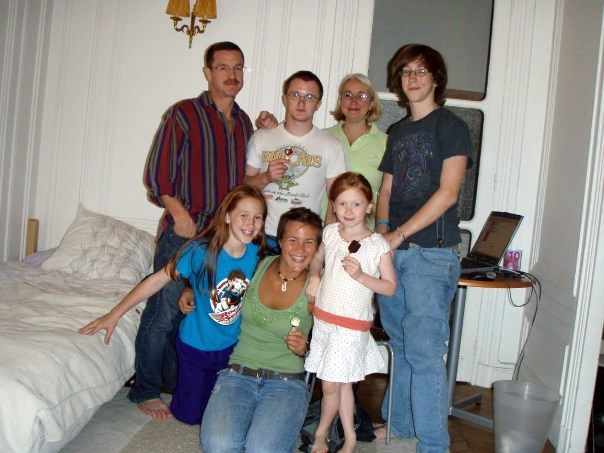
I stayed with the Schumacher family my last night in Paris. They were so friendly and fun!
So I've met up with Nik in Bangkok, and we've had an incredible first 48 hours here! But those blogs are to come later. For now, I sleep. And prepare for another great day in Thailand.
Posted by Whitney 09/05/2008



 goodells.net
 Web Design by Goodell
©1995-2026
Web Design by Goodell
©1995-2026

